
Hydrogeology
Hydrogeology is often required for understanding how water interacts with soils, rocks and geological formations, Hydrogeology provides critical insights for sustainable water management, flood control, soil conservation and groundwater recharge to rejuvenate springs and streams for year round water availability for local communities. At HIMGEO Consultancy Services Pvt. Ltd., we specialize in spring-shed and watershed management solutions. Our expertise covers every stage of the process, including site identification, prefeasibility assessments, delineation of potential recharge zones, proposal of site specific interventions favorable for groundwater recharge and detailed studies for DPR preparation. We design and recommend effective interventions to address critical challenges such as declining spring and stream discharge caused by urbanization, deforestation, climate change, and other human-induced impacts. Our Geological and GIS based analysis helps delineate Watershed and spring-shed boundaries and potential recharge zones for targeted intervention planning.
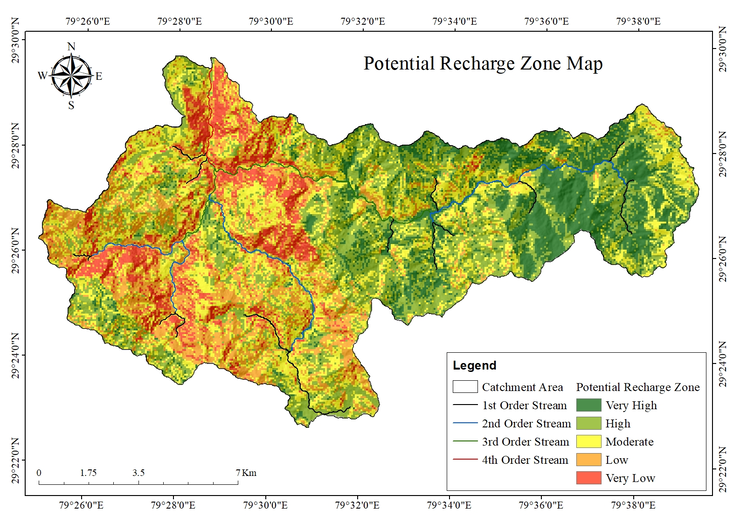
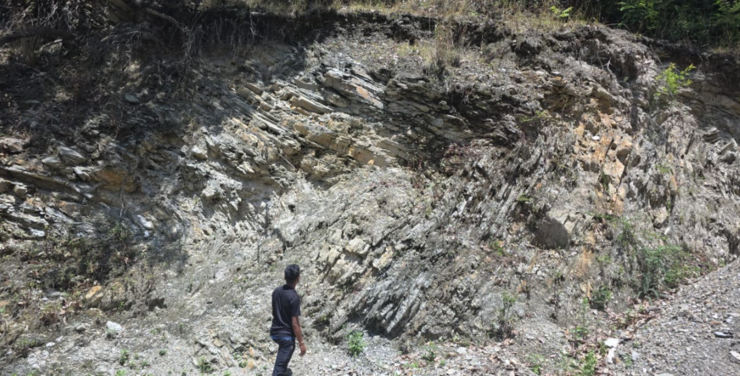
The potential recharge area of a spring-shed or watershed is identified to plan targeted interventions for maximizing groundwater recharge. Initial delineation is carried out in the field by analyzing lithology, bedding plane orientation, fracture sets, lineaments, and other structural features. This is followed by Analytical Hierarchical Procedures (AHP) in GIS, incase of a stream where thematic layers such as slope, land use/land cover, geology, drainage density, geomorphology, soil depth, and soil texture are integrated through weighted overlay. The analysis categorizes the catchment into zones ranging from very high to very low recharge potential, providing critical insights for selecting suitable sites and ensuring effective groundwater recharge interventions.
Physical as well as vegetative interventions are proposed in zones with high recharge potential aligned with the catchment’s physiographic and hydrogeological characteristics. This integrated approach combines engineering structures for runoff management and to check downstream sedimentation with ecological measures to reinforce the catchment’s soil health and water holding capacity. Physical Interventions: Construction of recharge structures such as contour trenches, recharge pits, dugout ponds, chal-khals, and check dams (loose boulder, random rubble masonry, gabion/crate-wire, cemented, and RCC) to check downstream sedimentation and water storage for irrigation. Vegetative Interventions: Practices like forestry plantations and fodder grass plantations are adopted to conserve soil and strengthen recharge areas.